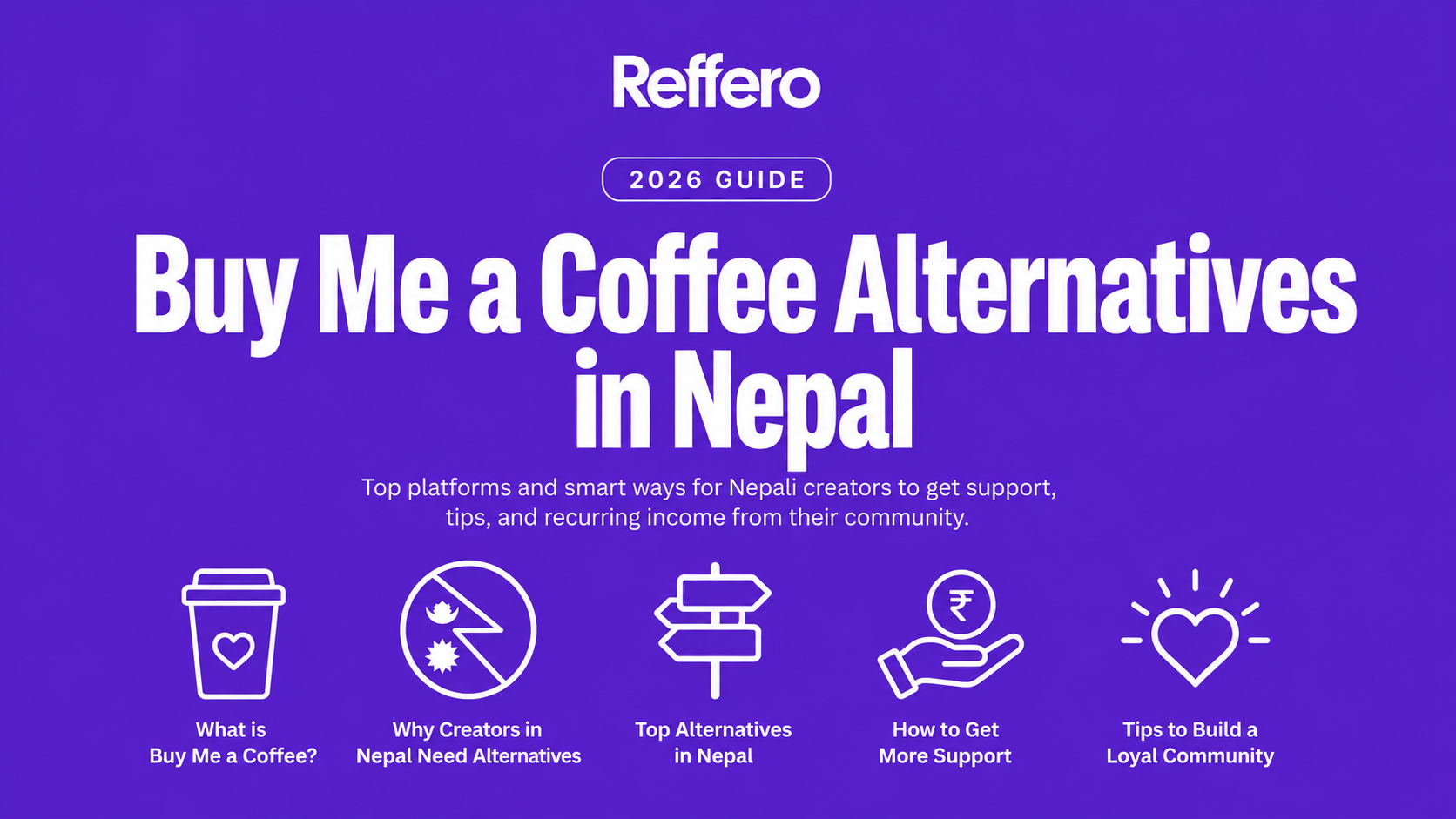
Buy Me a Coffee Alternatives in Nepal
Buy Me a Coffee, Ko-fi and Patreon pay out through rails Nepal cannot use. What actually works for Nepali creators who want direct audience support.
Someone in your comments says they want to support your work. You've seen creators abroad drop a "buy me a coffee" link and watched it work. So you go to sign up, get most of the way through, and hit the payout screen, where the options are a PayPal account you can't open and a US bank account you don't have.
This isn't a settings problem you can solve by trying harder. It's a structural one, and it's worth understanding properly, because the workaround most Nepali creators land on is worse than the problem.
Why the global tipping platforms don't work here
Buy Me a Coffee, Ko-fi, Patreon and every similar service are built on the same assumption: the creator can receive money through PayPal or a Western bank account.
Nepal isn't on PayPal's list of countries that can receive business payments. You can, in limited circumstances, send money out. Bringing money in through PayPal to a Nepali bank account isn't an approved route. Every global tipping platform inherits that limitation, because the payout rail is the product.
So a Nepali creator on Buy Me a Coffee ends up in one of three places:
- Money accumulates in a balance they can't withdraw. The tip button works. The payout doesn't.
- They route it through a relative or friend abroad. This works until it doesn't, and it's exactly the kind of informal channel that carries real legal risk. Nepal Rastra Bank treats informal transfer channels such as hundi, and buying cryptocurrency abroad to move funds, as illegal.
- They give up and stop asking, which is the most common outcome and the reason most Nepali creators have no direct support income at all.
There are legitimate partial routes. Payoneer does support Nepali users and is one of the more workable options for receiving foreign income. Nepal is also actively reforming its foreign exchange law, with provisions intended to make it easier for freelancers and digital service exporters to receive international payments through formal banking channels. That reform matters and is worth watching.
But none of it changes the practical reality for the specific thing we're talking about: a follower in Kathmandu who wants to send you NPR 100 right now, from their phone, in ten seconds. Routing a hundred-rupee tip through international banking is absurd. That transaction should never leave Nepal.
What the tip actually needs to do
Strip away the platform question and a creator tip has four requirements. In Nepal, only the first is straightforward on global tools.
- The supporter can pay in one tap, from the app they already have open. In Nepal that means eSewa, Khalti, IME Pay, or a bank app scanning a Fonepay QR. eSewa alone has more than 15 million users. This isn't a niche payment method, it's the default.
- The amount can be small. The whole point is a low-friction micro-payment. Any system with a minimum payout threshold in dollars kills it.
- The money lands in NPR, in a Nepali account, without a currency conversion or an intermediary.
- The creator doesn't need to explain anything. If supporting you requires instructions, most people won't do it.
Fonepay QR is the quiet hero here. A single QR code can be scanned by a supporter using their mobile banking app, eSewa, Khalti or another participating wallet, so you don't need a separate QR for each. That interoperability is what makes tipping in Nepal viable at all, and it's part of why COD and QR checkout decide creator commerce in Nepal.
The options that actually exist
A static QR code in your bio
The zero-cost version. Screenshot your eSewa or Fonepay QR, post it, pin it.
Works because: it costs nothing and everyone in Nepal knows how to scan a QR.
Breaks because: you get no record of who sent what, no way to thank anyone by name, no way to display it on a page rather than as an image, and no separation between your personal account and your creator income. At any volume, reconciling it is miserable, and you'll lose track of who supported you, which is the part that actually builds a community.
Direct bank transfer on request
Someone asks how to support you, you DM them your account number.
Works because: it's universal.
Breaks because: it doesn't scale past a handful of people, it puts your personal banking details in strangers' hands, and the friction means most people who intended to support you won't complete it.
A local creator platform with tipping built in
A page where the tip button, the amount, the local payment methods and the NPR payout are one integrated flow.
This is the category Reffero's Buy Me Chiya sits in, the same idea as Buy Me a Coffee but built on rails Nepal can actually use. A supporter taps, pays with a local method, and the money settles to you in rupees. A chiya costs NPR 50, so saying thanks should cost about the same and take about as long. We've written a full explainer on how Buy Me a Chiya works if you want the product detail rather than the comparison.
Works because: the payment method is one your audience already uses, the amounts can be small, and you get a record of who supported you.
Breaks because: you're dependent on the platform continuing to exist and operate well, the same trade-off creators anywhere make with any tool.
Global platforms with a workaround
Possible with Payoneer in some configurations, and genuinely useful for creators with substantial international audiences who are already receiving foreign income.
For a creator whose audience is overwhelmingly in Nepal, this is a lot of complexity, fees and currency conversion to solve a problem that has a local answer.
Tipping isn't a business model, it's a signal
An honest note, because a lot of advice on this topic oversells it.
Tips won't replace your income. For most creators, direct support is a small line item next to brand deals and commission selling. If you're choosing between setting up a tip button and setting up a way to sell products, sell products. It's a larger number by a wide margin.
What tipping is genuinely good for is different and still valuable:
- It proves your audience will transact with you. A follower who has sent you NPR 50 has crossed a psychological line. They're dramatically more likely to buy something you recommend later. That's the single most useful thing you can know about your own audience.
- It compounds with your other income. Tips sit alongside commission selling and brand deals rather than competing with them. See how to earn money from Instagram in Nepal for how the streams stack.
- It gives brands a data point. "My audience has paid me directly 340 times" is a much stronger pitch than a follower count, and it's exactly the sort of evidence that wins deals with a small audience.
- It costs nothing to add. If it lives on the same page as your store and links, there's no reason not to have it.
Think of it as instrumentation for audience trust, not as revenue. The revenue comes from what you learn.
Setting it up properly
Whatever tool you use, a few things make the difference between a tip button that gets used and one that gets ignored.
- Put it where the traffic already goes, on your link in bio, next to your store, not on a separate page nobody visits. See our comparison of link in bio tools for Nepali creators.
- Name the amount. "Buy me a chiya, NPR 50" converts better than an open field, because an open field makes people decide, and deciding is friction.
- Give a reason. Not a sob story. One line about what you're making and what support lets you keep making.
- Say thank you publicly, with permission. Visible gratitude is what makes the second person tip.
- Ask rarely. The creators who earn most from direct support are the ones who mention it least.
Buy Me Chiya is free and lives on your Reffero page next to your store and links. Your handle is probably still free.