Affiliate Marketing in Nepal: How It Actually Works
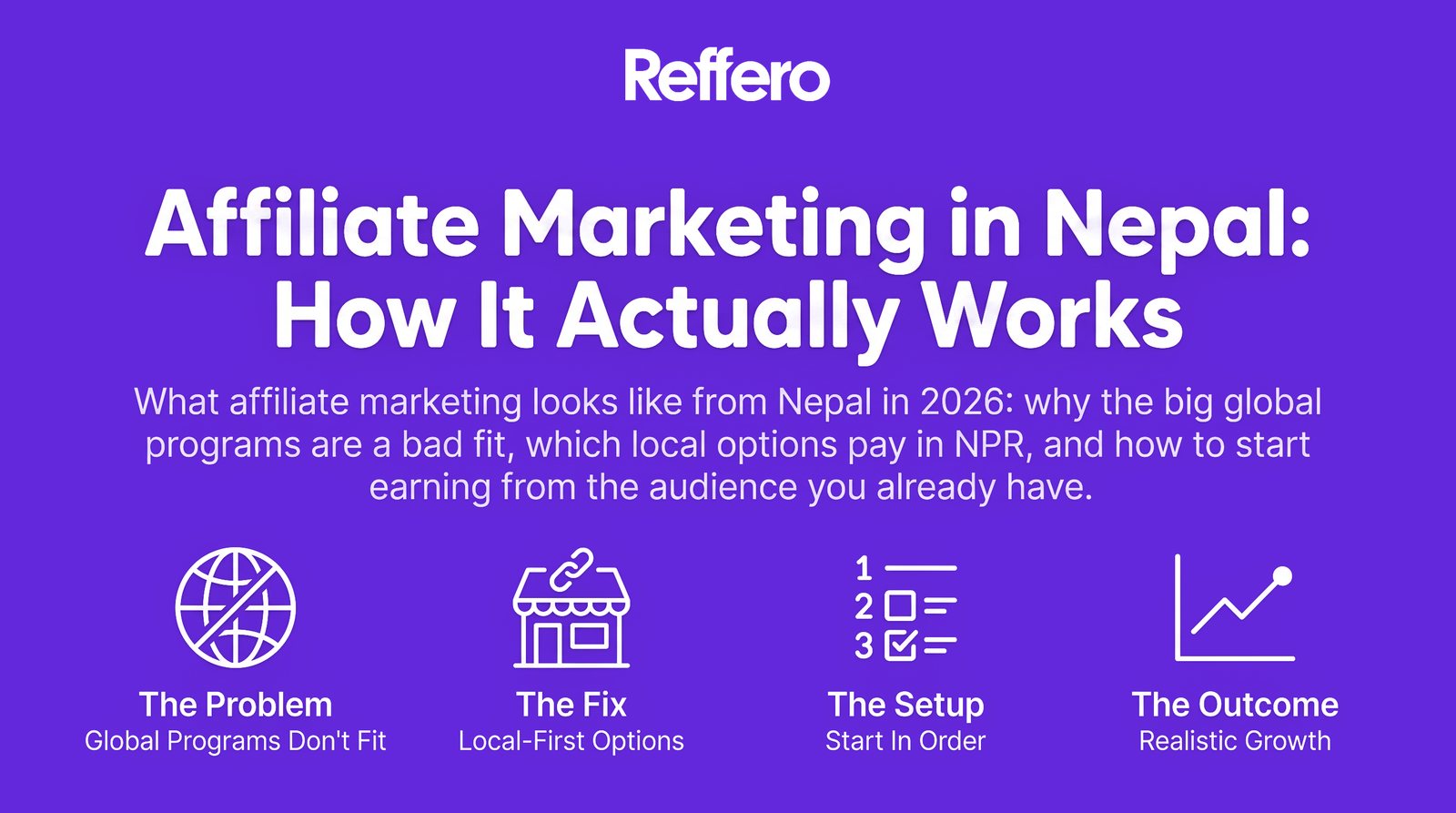
What affiliate marketing looks like from Nepal in 2026: why the big global programs are a bad fit, which local options pay in NPR, and how to start earning from the audience you already have.
Affiliate marketing is the simplest deal on the internet: you recommend a product, someone buys it through your link, you get a cut. No inventory, no customer service, no upfront cost.
The catch, if you live in Nepal, has never been the model. It's the plumbing. Most of the internet's affiliate infrastructure was built assuming you have a US bank account, a PayPal balance, and an audience that pays with credit cards. None of those assumptions hold here, so the playbook that works for a creator in Texas quietly fails for a creator in Kathmandu.
This guide covers what actually works from Nepal, and what to skip. If you want the platform-specific version of the same argument, we have one on earning money from Instagram in Nepal and one on earning money from TikTok in Nepal.
Why the global programs are a bad fit
The programs every YouTube tutorial recommends (Amazon Associates, ClickBank, the big SaaS affiliate networks) technically accept Nepali creators. In practice, three things break:
- Getting paid is painful. Payouts run through PayPal (which doesn't support receiving money in Nepal), direct deposit to foreign banks, or cheques. You end up routing money through relatives abroad or losing a chunk to intermediaries.
- Your audience can't buy. If your followers are in Nepal, an Amazon US link is close to useless. Most of them don't have international payment cards, and shipping to Nepal is slow and expensive when it's available at all.
- Commissions are thin. Amazon pays roughly 1–4% on most categories. That math only works at enormous traffic volumes, volumes a Nepali-audience creator selling to Nepali buyers will not see on foreign storefronts.
The lesson isn't "affiliate marketing doesn't work in Nepal." It's that your audience is in Nepal, so your links need to sell things Nepalis can actually buy, paid for the way Nepalis actually pay: cash on delivery, QR, wallets like eSewa and Khalti, and bank transfer.
What works: local-first affiliate options
Daraz Affiliate Program
Daraz is the biggest e-commerce catalogue in the country, and its affiliate program is the most common starting point. Your audience already knows it, delivery works, and cash on delivery is supported. Commission rates vary by category and are on the lower end, but conversion is decent because there's no trust barrier to buying.
Hosting and service affiliates
Local hosting companies and some fintech services run referral programs paying 10–25% per sale. These pay well per conversion but only make sense if your content is tech- or business-adjacent. A beauty creator sending followers to a web-hosting signup page converts at approximately zero.
Creator commerce platforms (this is where we should disclose: we build one)
The newest category, and the one we work on at Reffero, flips the model. Instead of dropping links to someone else's storefront, you get your own: a shop at reffero.bio/your_name built from products you pick. Checkout happens inside the platform with cash on delivery or QR payment, attribution is tracked server-side with a 30-day last-click window, and payouts are in NPR. Commission is a revenue share that grows as you sell: up to 92.5% of the commission on a sale stays with you at the top tier. The full journey of a rupee, from the click to the bank transfer, is in how Reffero commissions and payouts work, and the tier that sets your share is on the Reffero pricing page.
The honest comparison: Daraz gives you a bigger catalogue; a creator commerce platform gives you better commission economics, your own storefront, and attribution you can show to brands when negotiating deals. Many creators run both.
How to actually start (a realistic sequence)
- Pick a lane you already post in. Affiliate income follows trust. If your audience follows you for fashion, sell fashion. Random gadget links in a food account convert terribly.
- Start with products your audience can receive this week. Local delivery, COD or QR payment. Every extra step between "tapped your link" and "order confirmed" cuts conversion hard.
- Put the link where the tap actually happens. Instagram bio, TikTok bio, YouTube description, story sticker. One consistent link beats ten scattered ones, and the tool behind that link decides whether it can take a Nepali payment at all, which we compared in Linktree alternatives for Nepali creators.
- Track everything. If your program doesn't show you clicks and orders per link, you're flying blind, and you have no numbers to bring to a brand later. Server-side attribution matters more than people think: link-in-bio taps routinely lose browser cookies, so client-only tracking undercounts you.
- Talk about the product like a person, not a banner ad. The creators earning real commissions in Nepal are the ones showing the product in use, answering DMs about it, and reposting buyer photos. Recommendation is the product.
What a realistic outcome looks like
Nobody serious should promise you passive lakhs in month one. A realistic arc: your first commissions within a few weeks of posting consistently, meaningful side income once you've found two or three products that genuinely fit your audience, and (the part most guides skip) a track record of attributable sales that makes brands take your DMs seriously. Affiliate income and brand-deal income compound into each other: the click-and-order data from one is the proof you use to win the other. Turning that proof into a paid post is the subject of how to get brand deals in Nepal.
Reffero is creator commerce infrastructure built for Nepal: your own storefront, local checkout, and NPR payouts. If you want to see what your shop would look like, your handle is probably still free.