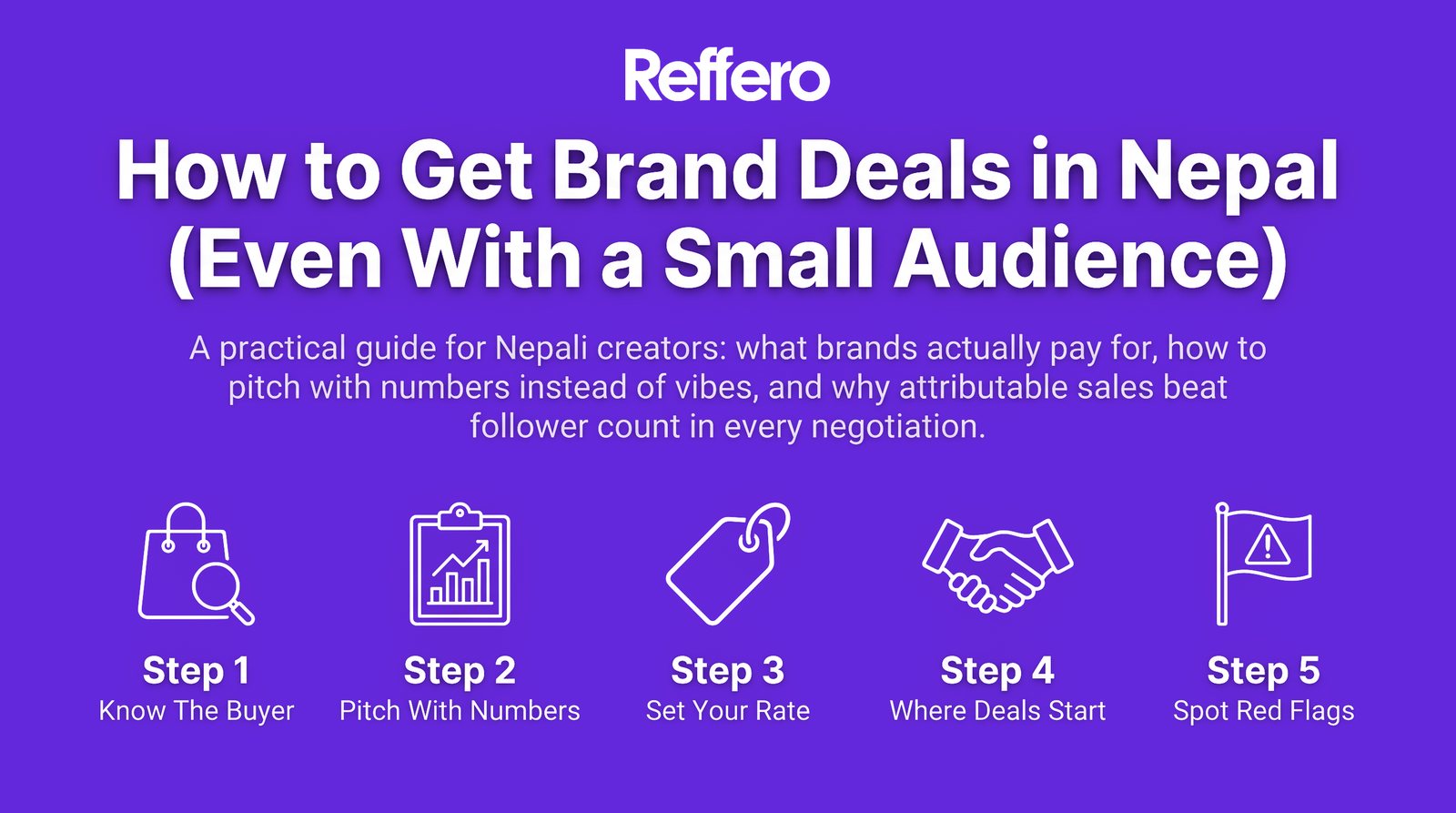
How to Get Brand Deals in Nepal (Even With a Small Audience)
A practical guide for Nepali creators: what brands actually pay for, how to pitch with numbers instead of vibes, and why attributable sales beat follower count in every negotiation.
Every Nepali creator with more than a few thousand followers has had the thought: people with smaller accounts than mine are getting paid posts. How?
The uncomfortable answer is that brand deals don't go to the biggest accounts. They go to the accounts that make the brand's decision easy. This guide is about becoming that account.
What brands in Nepal are actually buying
When a D2C brand, a fintech, or a restaurant group pays a creator, they're buying one of three things:
- Reach: eyeballs on a launch. This is the follower-count game, and unless you're one of the biggest accounts in the country, you'll lose it on price to someone bigger.
- Content: photos and videos they can rerun as ads. Your production quality matters more than your audience size here.
- Sales: orders they can trace back to you. This is the game small accounts can win, because a creator with 10,000 followers who demonstrably drives 40 orders is worth more than a creator with 200,000 followers who drives "brand awareness."
Most Nepali brands have been burned by option 1. They paid for reach, got screenshots of story views, and couldn't point to a single order. The market is shifting hard toward option 3, measurable creator marketing, and that shift is your opening.
The pitch that works: numbers, not vibes
A typical creator pitch is a DM that says "I love your brand, let's collaborate." Brands get dozens of these a week. Here's what stands out instead:
- Who your audience is, specifically. "62% women, 18–28, mostly Kathmandu valley" beats "engaged community."
- What you've sold before. Even one previous result changes the conversation: "My last skincare post drove 27 tracked orders" is a different species of sentence than "my followers love skincare."
- What you're proposing. One reel plus three stories, a specific week, a specific product. Make the yes easy.
- How they'll know it worked. Offer a trackable link or a discount code. A creator volunteering to be measured signals confidence, and it means when it works, you have receipts for the next negotiation.
If you don't have sales numbers yet, that's the actual first problem to solve, not follower growth. (If you don't have much of an audience yet either, work through the realistic roadmap to becoming an influencer in Nepal first, then come back to this.) Start with affiliate or commission-based selling so every order gets attributed to you, which is the whole subject of our guide to affiliate marketing in Nepal. A month of commission data is a better media kit than any follower graph. (This is exactly the flywheel we built Reffero around: your storefront tracks every click and order server-side, so your track record builds itself while you earn commissions.)
Pricing: how to think about your rate
There's no honest public rate card for Nepal, and anyone quoting you one is guessing. What you can do is price from first principles:
- Floor: what the work costs you in shooting, editing, and time. Never go below it for "exposure."
- Value case: if you can show past conversion, price against results. A brand making Rs 1,500 margin per order will happily pay a creator who reliably drives 50 orders far more than one who "reaches" 100k people.
- Barter is fine at the start, with limits. Product-for-post is a legitimate way to build a portfolio with brands you actually use. Set a limit: after your first few, real collaborations should have money attached, or a commission structure so upside is shared.
- Commission-plus-fee is the strongest structure for small creators. A modest flat fee covers your production floor; commission on tracked sales gives you upside and gives the brand safety. It's the easiest structure for a skeptical brand to say yes to. If you want to know why it lands, read the same deal from the buyer's side in our influencer marketing guide for brands.
Where deals actually come from
- Inbound looks passive but is built deliberately. Brands scout creators who already talk about their category. Tag brands you genuinely use, keep your niche legible, and make your contact info findable.
- Cold outreach works when it's specific. Ten researched pitches to brands whose products you've actually used will outperform a hundred copy-pasted DMs.
- Platforms and marketplaces. Creator platforms increasingly route brand campaigns directly to creators on them. On Reffero, brand collabs arrive in the same account you sell from, with the budget and deliverables stated up front, so you're negotiating from your sales data instead of your follower count. The application, counter offer, contract, and draft steps are walked through in how to get PR packages and paid collabs on Reffero, and the rest of what a Reffero creator account carries is on our creator page.
- Other creators. Most working creators in Nepal got their early deals through referrals from creators one tier above them. Community is distribution.
Red flags worth refusing
- "Payment after we see the results" with no tracking mechanism agreed in advance. That's unpaid work with extra steps.
- Briefs that want full ad-style control of your voice. Your audience follows you because you don't sound like an ad; a deal that erases that spends down the exact asset you're selling.
- No written agreement. A simple message thread stating deliverables, dates, amount, and payment timing counts. No terms at all doesn't.
The compounding loop
The creators who end up with steady brand income in Nepal all run some version of the same loop: sell something trackable → use the numbers to win a brand deal → the deal's results become next quarter's pitch. Follower count grows slowly and lies constantly. A record of attributed orders grows every week and never needs explaining. Run both halves on a single post and one reel can carry a fee and a commission at the same time, the move we broke down in one post, two paychecks.
Start the loop with whatever audience you have today. It's smaller than you'd like. It's also bigger than most working creators had when they started theirs.
Reffero gives Nepali creators one account for both halves of the loop: a storefront with tracked, attributed sales, and brand collabs that come to you. See if your handle is still free.